
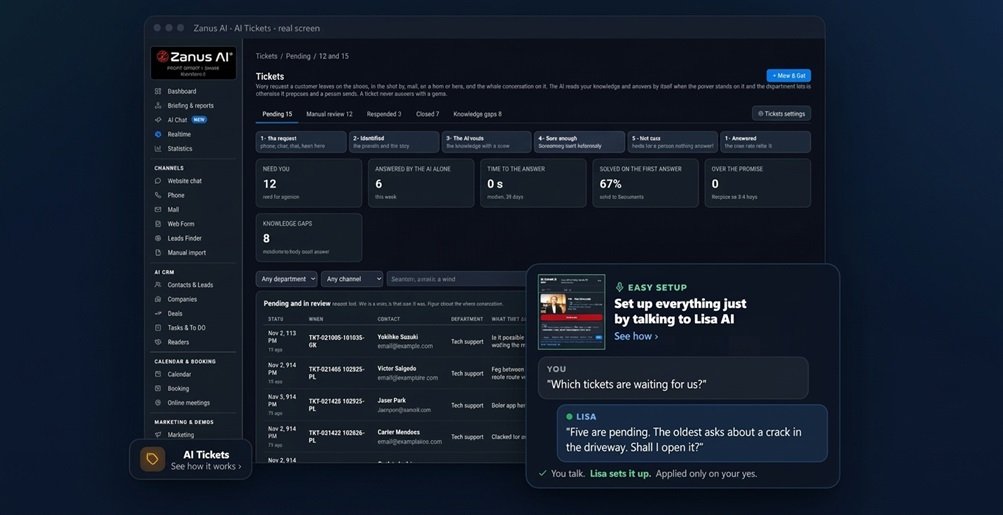
Zanus AI is described as a private AI system whose voice agent answers calls, handles routine requests, and routes conversations to people. Unlike a cloud-only phone assistant, it is designed to process conversations on hardware inside an organization’s own environment. For businesses considering the AI voice agent Zanus, the central question is whether that extra control justifies the hardware, integration, and ongoing operational work.
The distinction matters more than how convincing a demo sounds. A receptionist that answers questions is one thing; a system connected to appointments, customer records, and confidential conversations is a much bigger responsibility.
What is Zanus AI’s voice agent?
Zanus is presented as more than a standalone voice app. It combines an on-premises AI server with software for business workflows, an internal knowledge base, access controls, and audit logging. Its voice agent is one module within that broader system.
On-premises simply means the processing runs on infrastructure the organization controls, rather than relying on a vendor’s external cloud for the core AI work. In Zanus’s described setup, that includes local language models running on GPU-equipped hardware, specialized computing equipment used to run the AI.
Think of it this way, you’re not just choosing a voice. You’re choosing where the conversation is processed and who operates the system behind it.
How does it turn a call into an answer?
The on-premises voice architecture described for Zanus includes telephone connectivity, speech recognition, a language model, speech generation, and storage for logs and analytics. Each part has a different job:
- Telephone connection: brings the call into the system and connects the agent with the organization’s phone infrastructure.
- Speech recognition: turns the caller’s speech into text the system can process.
- Language model: interprets the request and generates a response, using prompts, internal documents, and connected tools where configured.
- Speech generation: turns the response into spoken audio.
- Workflow connections: let the conversation lead to actions such as scheduling an appointment or updating a customer record.
Zanus’s internal knowledge base is described as using a vector database, which helps the AI find relevant information in company documents. That is how its answers can draw on an organization’s policies and procedures instead of relying only on the model’s general knowledge.
In our view, this connection to business information matters more than a polished speaking voice. An assistant needs the right policy before it needs a pleasing delivery.
What can it reportedly do?
Zanus’s voice agent is a supporting conversation tool that retain context across several exchanges, rather than limiting callers to fixed phone menus. It also lists these uses:
- Reception: answer inbound calls, take messages, and route callers.
- Appointments: book, reschedule, or cancel appointments through connected scheduling systems.
- Customer questions: answer from the organization’s own documents and policies.
- Sales intake: qualify leads using business-defined criteria and pass information to a customer relationship management system, or CRM.
- Employee support: answer questions about internal HR policies, IT procedures, or manuals.
- Human handoff: escalate conversations and pass along a summary.
Consider an appointment call, in the workflow described, the caller asks to change a booking, the agent works with the connected scheduling system, and a request outside its configured scope goes to a person. The useful outcome is the completed scheduling task not simply a plausible spoken answer.
These are reported capabilities, not a guarantee that every deployment includes every connection. The setup as described in their documentation includes configuring phone integrations, scheduling or CRM connections, routing logic, and escalation rules.
Does local processing mean it works offline?
Zanus’s core AI functions includes conversation handling and document search, it can operate without an active internet connection because the models run locally. It also have voice processing, recordings, and transcripts as staying within the customer’s infrastructure.
Local AI processing is not the same as an entirely disconnected business workflow, the voice system still has telephone connections and may connect to scheduling or CRM tools. Our view is that an offline claim should be understood narrowly: it describes the local AI engine, not a promise that every connected service keeps working during an outage.
What does Zanus AI cost?
The official website reports no fixed public pricing for it voice-agent deployments. Instead, pricing is customized around the deployment’s scope.
The listed cost drivers include concurrent calls, overall call volume, receptionist versus full call-center requirements, integrations, and industry-specific compliance needs. Concurrent calls means the number of conversations the system must handle at the same time.
Zanus is described as using an ownership model with no required subscriptions and no per-token fees for internal work. Tokens are the units used to meter language-model processing. But that should not be confused with a system that costs nothing to operate.
The deployment involves hardware and setup, while ongoing operation includes monitoring and updating the knowledge base. Without an itemized quote, there is no sound basis for declaring it cheaper than a cloud alternative. In our view, the meaningful comparison is total operating cost, not the absence of one billing category.
What are the trade-offs?
More control, more operational responsibility
The main attraction is control over infrastructure and conversation data. The corresponding burden is running the system while the deployment guidance covers hardware, integration, monitoring, access permissions, and retention policies.
That makes Zanus a different kind of tool from a simple subscription app. In our view, it is better treated as an infrastructure project with a voice interface.
Response speed still matters
Running locally does not automatically eliminate delays. The deployment playbook identifies competing GPU workloads, slow storage, oversized models, and excessive conversation context as possible causes of poor response times.
It recommends measuring the delay before the caller hears the first response audio, including during peak demand. A short demonstration cannot establish how a system behaves when several calls and other computing jobs compete for resources.
Private does not automatically mean compliant
Zanus is described as including role-based access controls and audit logs: restrictions on who can access information, plus records of system activity. The deployment playbook also emphasizes retention rules, redaction, and control over model changes.
In our view, local storage is a useful architectural choice, not a complete compliance verdict. Organizations still need clear decisions about who can hear recordings, how long transcripts remain available, and which actions the agent may take.
Who is it best suited to?
The described use cases emphasize healthcare, legal services, financial services, and government organizations, settings where confidential conversations and data location can be significant concerns.
In our view, Zanus makes the most sense for an organization with a clear reason to keep AI processing under its control and the capacity to operate that infrastructure. It looks less compelling for an individual who simply wants a quick voice assistant without a hardware project.
The strongest starting point is a narrow responsibility: answering approved questions, managing a defined appointment flow, or routing calls. Those are all described uses of the platform. Give the agent a clear boundary and a useful human handoff; a convincing voice should never be mistaken for unlimited authority.

1 comment